Running a small business has always meant doing five jobs at once. You’re the marketer on Monday, the bookkeeper on Wednesday, and the customer support rep whenever someone emails at 9 p.m. What’s changed is that the software finally caught up. AI tools for small business owners have dropped in price, gotten far easier to set up, and stopped requiring a developer to make them work. A shop owner can now draft a month of social posts, sort receipts, and answer routine customer questions before the first coffee goes cold.
The hard part is no longer access. It’s choosing. Search “AI software” today and you’ll find thousands of products, most of them built for enterprise teams with enterprise budgets, all claiming to do everything. That noise costs you time and money when a trial turns into a subscription you never use. This guide cuts through it with tested picks organized by the work you actually need done, from writing and marketing to accounting, sales, and support.
Why Small Businesses Are Adopting AI in 2026
Two years ago, most AI tools for small business owners tried clunky add-ons bolted onto bigger platforms built for enterprise use. Now they’re designed specifically for lean teams, with pricing tiers starting under twenty dollars and setup that takes minutes, not weeks.
The real gains show up in unglamorous, everyday work: writing follow-up emails, tagging expenses, scheduling social posts, and answering repetitive customer questions. Many owners report reclaiming several hours each week, time that goes straight back into sales, service, and actually growing the business.
A common misconception is that adopting AI means replacing staff or handing over every decision to a machine. In practice, it works best as a quiet assistant that handles routine tasks in the background, freeing people to focus on the judgment calls only a human should make.
How We Chose the Best AI Tools for Small Businesses
Not every well-reviewed app belongs on a small business shortlist. Before recommending any product here, we weighed it against four practical criteria: price relative to what a small team can justify, how quickly someone with no technical background can get value from it, how well it connects with everyday software like email, accounting platforms, and e-commerce tools, and whether real customer support exists when something breaks.
We also tested for a specific kind of overselling common among AI tools for small business buyers: features that look impressive in a demo but require a dedicated IT person to maintain. Anything requiring that level of upkeep was excluded.
These picks are built for owners and small teams, typically under fifty employees, who need results fast and can’t afford a long learning curve. If that sounds like you, the recommendations ahead should map closely to your day-to-day priorities.
Best AI Tools for Small Businesses at a Glance
If you’re short on time, here’s the fast version. The table below breaks down our top AI tools for small business owners by category, price range, and standout feature, so you can scan and click through to whatever matches your immediate need instead of reading the full guide top to bottom.
| Category | Best For | Starting Price |
| Writing & Content | Blog posts, product copy | Free–$20/mo |
| Marketing & Social | Scheduling, ad copy | Free–$29/mo |
| Customer Support | Chat, ticketing | Free–$19/mo |
| Accounting | Invoicing, expense tracking | Free–$15/mo |
| Sales & CRM | Lead tracking, outreach | Free–$25/mo |
Business type matters too. A solo freelancer’s priorities look nothing like a ten-person retail shop’s. The sections ahead group recommendations by function first, so whether you run a service business or sell physical products, you’ll find picks suited to how you actually work.
Best AI Writing and Content Tools
Content creation is often the first place small businesses turn to AI tools for small business owners to recommend, since drafting blog posts, product descriptions, and marketing emails can eat entire afternoons. Our top pick combines a clean interface with strong long-form output, making it easy to go from a rough idea to a publish-ready draft in minutes rather than hours.
For tighter budgets, a solid free-tier option handles short-form copy like social captions and email subject lines without asking for a card upfront, which is ideal for testing whether AI writing fits your workflow before committing money.
Pricing across this category typically ranges from free plans with word limits to around twenty dollars a month for unlimited generation, plagiarism checks, and tone customization. Look for built-in SEO suggestions and multi-language support if your customers aren’t all English speakers, since these features often separate genuinely useful tools from basic templates.
Best AI Tools for Marketing and Social Media
Once your content engine is running, marketing is where AI tools for small business owners see some of the fastest returns, especially around scheduling and staying consistent across platforms. Our top pick handles multi-platform posting, suggests optimal send times based on audience activity, and generates caption variations so you’re never staring at a blank box before a deadline.
For paid campaigns, a separate standout focuses specifically on ad creative and copy, generating multiple headline and image variations you can A/B test without hiring a designer or copywriter. This matters most for businesses running Facebook or Google ads on tight budgets, where every wasted impression counts.
Pricing generally starts free for basic scheduling, climbing to around thirty dollars monthly for advanced analytics, unlimited social accounts, and ad-creative generation. Prioritize tools with built-in performance tracking, since knowing what’s working matters more than posting volume alone.
Best AI Tools for Customer Support
Marketing brings customers in, but keeping them happy is where AI tools for small business owners often feel the most immediate relief, since support questions tend to pile up fastest and hurt the most when ignored. Our top pick manages ticketing across email, chat, and social messages in one inbox, automatically sorting urgent issues from routine ones so nothing slips through overnight.
For teams without dedicated support staff, a lightweight chatbot option handles common questions like shipping times, return policies, and store hours around the clock, escalating anything it can’t confidently answer to a real person instead of guessing.
Pricing typically starts free for basic chatbot functionality, moving to around twenty dollars monthly for shared inboxes, canned responses, and reporting on response times. Look for easy handoffs between bot and human, since customers get frustrated fast when a chatbot loops without a clear way to reach someone real.
Best AI Tools for Sales and CRM
With finances under control, attention naturally shifts to keeping the sales pipeline full, and this is another area where AI tools for small business owners lean on to stay organized without hiring a dedicated sales team. Our top pick tracks every lead automatically, logs interactions from email and calls, and nudges you when a deal has gone quiet, so nothing valuable falls through the cracks between conversations.
For businesses focused on filling the top of the funnel, a standout lead generation tool finds and scores prospects based on your ideal customer profile, then drafts personalized outreach emails that read like a person wrote them rather than a mail merge.
Pricing typically starts free for basic contact management, rising to around twenty-five dollars monthly for automated follow-ups, lead scoring, and pipeline forecasting. The best options here integrate directly with your inbox, so sales activity stays visible without forcing your team into a separate tool all day.

Best AI Tools for Design and Video
A steady sales pipeline still needs visuals to back it up, and this is where AI tools for small business owners often replace what used to require a freelance designer or video editor on retainer. Our top pick generates social graphics, product mockups, and short promotional videos from simple text prompts, complete with brand kit support so colors and fonts stay consistent across every piece you create.
For businesses testing the waters before committing to a paid plan, a genuinely useful free option offers templates for common formats like Instagram posts and YouTube thumbnails, with enough customization to look polished without a watermark forcing an upgrade.
Pricing generally starts free for basic templates, moving to premium tiers for advanced video editing, stock footage libraries, and higher-resolution exports. For visually driven businesses like retail or food service, this category often delivers the most noticeable brand improvement for the least amount of daily effort.
Best AI Tools for Automation and Workflows
Great visuals and organized sales data only go so far if the work connecting them is still manual, which is why automation rounds out this list of AI tools for small business owners to rely on to tie everything together. Our top pick connects the other apps you’re already using, automatically moving data between your CRM, inbox, and accounting software so information updates everywhere at once instead of requiring copy-paste between tabs.
For owners without technical experience, a strong no-code option uses a simple drag-and-drop builder to create workflows like “send a welcome email when someone fills out a form” in minutes, no coding knowledge required.
Pricing usually starts free for a limited number of monthly automations, with paid tiers around twenty dollars unlocking multi-step workflows and premium app integrations. This category tends to have the highest payoff over time, since one well-built automation can quietly save hours every single week.
Free vs Paid AI Tools: What’s Worth Paying For
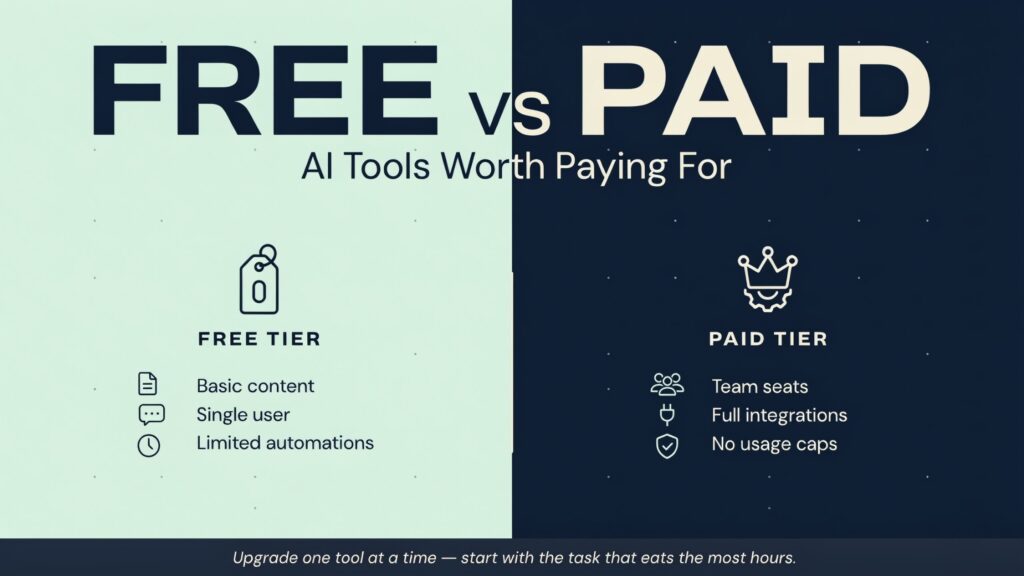
After going through each category, a natural question comes up: do you actually need to pay for any of this? Free plans across most AI tools for small business owners are more capable than they used to be, typically covering basic content generation, limited automations, and single-user access, enough to run a lean operation without spending a dollar in the early stages.
The upgrade becomes worth it once limits start costing you time rather than saving it. Signs include hitting monthly usage caps mid-project, needing multiple team members in one account, or wanting integrations that free tiers usually lock behind a paywall.
A good rule of thumb: upgrade one tool at a time, starting with whichever task currently eats the most hours in your week. Paying for five tools at once rarely makes sense before you’ve confirmed each one actually earns its place in your workflow.
How to Choose the Right AI Tools for Your Business
With so many categories covered, narrowing things down comes back to your own business rather than any generic best-of list. Start by identifying whichever task drains the most hours each week, whether that’s writing, customer replies, or bookkeeping, since the right AI tools for small business owners choose are usually the ones solving a problem they already feel, not one they’re told they should have.
Before signing up for anything, check how well a tool fits into what you’re already using. A brilliant app that doesn’t connect to your email or accounting software creates more manual work, not less.
Finally, weigh your budget against your team size honestly. A solo owner rarely needs the same tier as a ten-person team managing shared accounts. Pick tools that scale with you, so you’re not paying for seats or features that sit unused for months at a time.
How to Implement AI Tools Without Disrupting Your Team
Choosing the right software is only half the challenge; rolling it out without disrupting daily operations is where many small businesses stumble. The safest approach with new AI tools for small business teams adopt is starting with a single workflow, like automating one email sequence, rather than overhauling everything at once and overwhelming staff in the process.
Training matters more than most owners expect. A short walkthrough, even fifteen minutes, dramatically increases how much a team actually uses a new tool instead of quietly reverting to old habits within a week.
To know if it’s working, measure something concrete: hours saved, response times, or revenue tied to a specific workflow. Vague impressions of “this feels helpful” don’t hold up when renewal time comes around. Give any new tool a full month before judging it, since early weeks usually involve a learning curve before real time savings show up.
Risks and Limitations to Keep in Mind
Before adopting anything from this list, it’s worth being honest about the downsides too. Many AI tools for small business owners use process sensitive information like customer emails, payment details, or contracts, so checking a provider’s data policy matters more than it might seem, especially if you handle health, legal, or financial records.
Accuracy is another area that deserves caution. AI-generated content, financial summaries, and customer replies can sound confident while still being wrong, so human review remains essential for anything client-facing or tied to compliance, rather than trusting output blindly.
Finally, watch for vendor lock-in. Some tools make it easy to import data but difficult to export it later, and introductory pricing has a habit of climbing sharply after the first year. Read cancellation terms before committing, and revisit pricing annually rather than assuming your rate stays fixed for good.
H2: Frequently Asked Questions
H3: What Are the Best AI Tools for Small Business?
The best AI tools for small business owners depend on your biggest need, but top picks generally cover writing, marketing, support, and accounting. Start with one tool solving your most time-consuming task, then expand from there.
H3: How Much Do AI Tools Cost for Small Businesses?
Most AI tools for small business owners use range from free to around $30 a month per tool. Costs rise with more users, higher usage limits, and advanced features like automation or analytics.
H3: Are There Free AI Tools for Small Businesses?
Yes, many AI tools for small business needs offer free tiers, including basic content writing, scheduling, invoicing, and chatbots. Free plans work well early on but often cap usage as you grow.
H3: Can AI Tools Replace Employees in Small Business?
No, most AI tools for small business owners rely on are built to support staff, not replace them. They handle repetitive tasks like data entry or replies, freeing people for higher-value work.
H3: How Do I Pick the Right AI Tool for My Business?
Choosing the right AI tools for small business operations starts with identifying your biggest time drain, checking integrations with existing software, and testing free plans before upgrading to paid tiers.
H2: Final Verdict: Our Top AI Tool Picks for 2026
There’s no single “best” tool on this list, only the one that solves the problem costing you the most time right now. If you’re drowning in content, start with a writing assistant. If customer emails pile up overnight, a support tool pays for itself in the first week. The right mix of AI tools for small business operations depends entirely on where your day actually goes, not on which app has the flashiest demo.
If you’re starting from zero, a practical path is: one content tool, one scheduling or support tool, and one automation connecting them. That combination alone eliminates a surprising amount of manual work without requiring a big budget or a learning curve that eats into the time you’re trying to save.
Whatever you choose, start small, measure the results after a month, and build from there. The businesses getting the most out of AI in 2026 aren’t the ones using the most tools, they’re the ones using the right few consistently.