
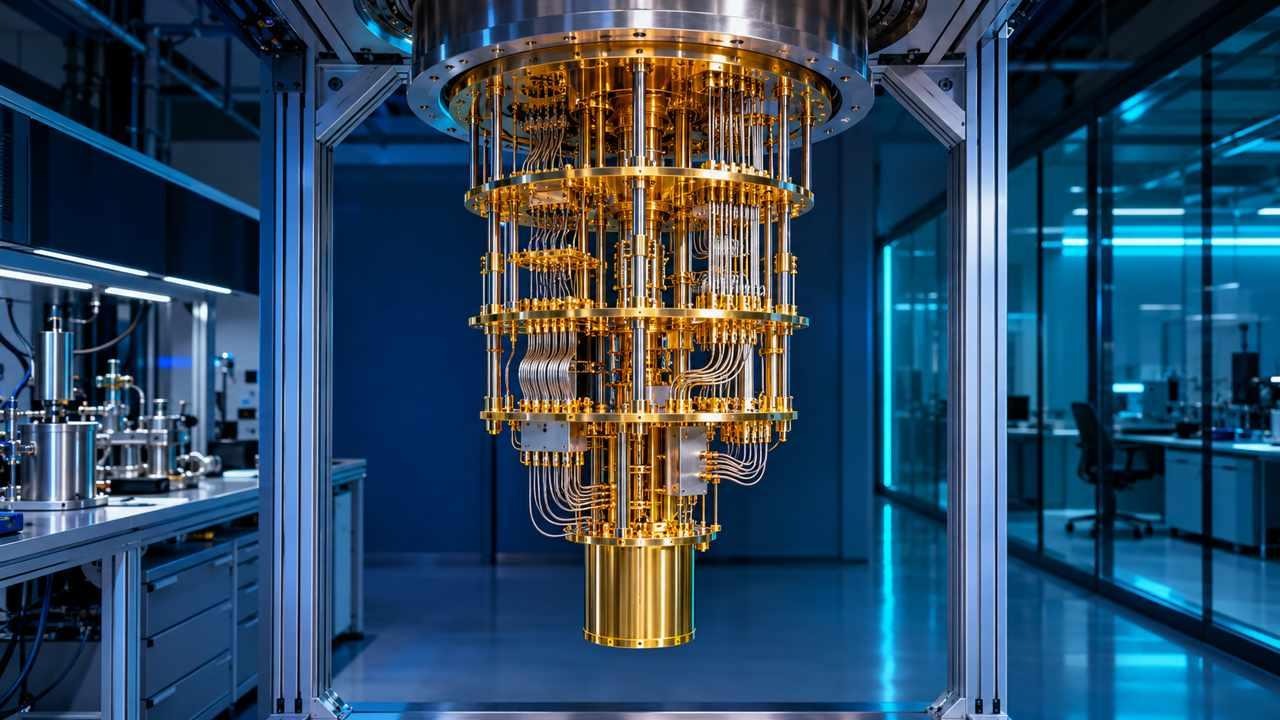
Quantum Computing Breakthroughs in 2024 Explained
Today’s breakthroughs in quantum computing in 2024 introduced a change in awareness. Researchers found ways to protect quantum records instead of just focusing on large processors. Google made progress with error-corrected quantum memory. Microsoft and Quantinuum worked on qubits. IBM made more circuits available to researchers.
These achievements are counted due to the fact errors nonetheless interrupt quantum calculations lengthy before many useful algorithms can end. Better reliability offers researchers a more potent basis for tackling that trouble. It does no longer mean quantum computers have become widespread-purpose replacements for laptops or supercomputers.
This guide critiques trends announced at some stage in 2024. It explains what the outcomes tested, wherein their limits remain, and which measures assist readers judge quantum computing information without getting lost in headline numbers.
Latest breakthroughs in quantum computing 2024 at a glance
The table separates experimental computing milestones from related cybersecurity development. Dates refer to announcements, rather than predictions about commercial availability.
| Date in 2024 | Development | What it demonstrated |
| April 3 | Microsoft and Quantinuum | Four logical qubits; experiment-specific error reduction |
| August 13 | NIST standards | Three finalized classical post-quantum algorithms |
| September 10 | Microsoft and Quantinuum | 12 logical qubits; additional error-corrected operations |
| November 13 | IBM Heron R2 | 156 qubits; circuits up to 5,000 two-qubit gates |
| December 9 | Google Willow | Below-threshold surface-code quantum memory |
Together, these developments showed progress across hardware, error correction and software. Each result answers a different question, so comparing them using qubit counts alone would be misleading.
The basics behind the breakthroughs
A classical bit has a value of zero or one. A qubit has a quantum state that can involve both possibilities, while entanglement creates correlations between qubits. Quantum algorithms use these properties and interference to change the probabilities of measurement outcomes.
This does not let a computer read every possible answer simultaneously. An algorithm must steer the system toward useful results, and measurements return limited information.
Three terms make the latest breakthroughs in quantum computing 2024 easier to understand:
- Physical qubits are the hardware components that hold quantum states.
- Logical qubits encode information across physical qubits so errors can be identified and managed.
- Fault tolerance means carrying out computation while preventing physical errors from spreading into unmanageable logical failures.
Error mitigation is different from error correction. Mitigation estimates or reduces noise effects in results; it does not by itself create the protected logical operations needed for large fault-tolerant algorithms.
Google Willow improved quantum error correction
Google announced its 105-qubit Willow processor on December 9, 2024. Its most consequential result concerned surface-code quantum memory: increasing the protection around an encoded qubit reduced its logical error rate.
In the tested configurations, moving to larger codes approximately halved errors at each increase in code distance. This is called the below-threshold operation. It demonstrates that additional hardware can improve protection when physical operations are sufficiently reliable.
Among the latest breakthroughs in quantum computing 2024, this result addressed a fundamental scaling question. However, protecting a quantum memory is one part of building a computer. Useful fault-tolerant machines also need dependable logical gates and much larger systems.
Latest breakthroughs in quantum computing 2024 and benchmark limits
Google also reported a random circuit sampling result completed in under five minutes. Its striking classical-runtime comparison was an estimate for that specific benchmark and the simulation methods considered.
It was not evidence that Willow could perform drug discovery, forecasting or ordinary office tasks at the same speed advantage. Benchmark results should always be read alongside their assumptions.

Microsoft and Quantinuum expanded logical qubits
In April 2024, Microsoft and Quantinuum reported four logical qubits encoded using 30 physical qubits. The reported 800-fold error-rate improvement applied to the corresponding experimental comparison, rather than every possible quantum calculation.
September brought another milestone: 12 logical qubits on Quantinuum’s H2 trapped-ion system. The companies reported a 22-fold improvement over the physical circuit comparison when preparing an entangled 12-qubit state. They also demonstrated repeated error correction combined with computation on eight logical qubits.
This distinction matters when reviewing the latest breakthroughs in quantum computing 2024. The April and September improvement factors describe different experiments and cannot be treated as one universal performance score.
Logical qubit quality, available operations and circuit depth provide more useful context than a single headline number.
IBM advanced the hardware and software stack
IBM’s November 2024 update described its second-generation Heron processor, with 156 qubits, and calculations using circuits containing up to 5,000 two-qubit gates. The announcement linked those capabilities to improvements across hardware and the Qiskit software stack.
A quantum gate changes a quantum state. More usable gate operations can let researchers explore more involved circuits, provided noise and result quality remain manageable.
The latest breakthroughs in quantum computing 2024 therefore included improvements to the tools surrounding processors. Circuit compilation, noise handling and classical processing can affect what an experiment actually achieves.
IBM’s reported capability should not be read as proof that every circuit of that size beats the best classical alternative. Useful quantum advantage depends on the particular workload, accuracy requirements and total resources used.
What these advances mean for practical applications
The latest breakthroughs in quantum computing 2024 strengthened research tools, but applications still need careful validation. A useful result must offer an advantage over competitive classical methods, not simply run on quantum hardware.
Chemistry and materials research
Molecules follow quantum mechanics, making quantum simulation a plausible route to studying difficult chemical behavior. Potential targets include catalysts, battery materials and molecular interactions.
Microsoft’s September demonstration combined two logical qubits with AI and cloud high-performance computing to estimate an energy associated with a catalytic intermediate. It illustrated an integrated research workflow; it did not establish a broad commercial quantum advantage.
Optimization and machine learning
Scheduling, logistics, portfolio modeling and quantum machine learning attract research interest. Their commercial promise depends on more than the number of possible combinations in a problem.
Researchers must compare accuracy, runtime, data preparation and hardware costs against strong classical baselines. A theoretically attractive algorithm may lose its advantage once those practical requirements are included.

Post-quantum security reached a separate milestone
On August 13, 2024, NIST finalized three post-quantum cryptography standards: ML-KEM for key establishment, and ML-DSA and SLH-DSA for digital signatures.
These algorithms run on classical systems. Their standardization was a security response to future quantum capabilities, rather than a breakthrough in quantum processor performance.
For businesses considering the latest breakthroughs in quantum computing 2024, this was an actionable development. Long-lived sensitive information and lengthy technology migrations make advance preparation valuable.
A sensible starting point is to identify where public-key cryptography is used, ask suppliers about migration support, and prioritize systems protecting information with long confidentiality requirements. Implementation should follow established standards and appropriate technical review.
NIST’s official standards announcement provides the authoritative starting point for understanding the three algorithms and their roles.

How to judge quantum computing claims
When reading about the latest breakthroughs in quantum computing 2024, ask what the experiment actually measured. Five questions help:
- Was the result a protected memory, a logical operation or an application?
- What error rate was measured, and against which baseline?
- Were physical qubits or logical qubits being counted?
- Did the classical comparison use competitive algorithms and matching accuracy?
- Were resource estimates demonstrated experimentally or projected?
Also check the announcement date. A roadmap describes intended engineering progress, while a published experiment describes work already performed. Neither guarantees when an affordable, commercially useful machine will arrive.
Conclusion
The latest breakthroughs in quantum computing 2024 made quantum information more controllable and research systems more capable. Willow supported a path toward scalable error-corrected memory, logical-qubit experiments advanced, and IBM improved the circuits researchers could explore.
The practical lesson is to follow reliable operations and application evidence alongside hardware size. For businesses, security preparation offers a concrete task; for developers and students, learning quantum circuits and testing small experiments remains a useful way to build understanding.
Frequently asked questions
What was the biggest quantum computing breakthrough in 2024?
Willow’s below-threshold error-correction result was a major milestone. It showed that enlarging the tested surface codes improved logical memory reliability, a necessary building block for future fault-tolerant systems.
Did quantum computers replace classical computers in 2024?
No. The reported results concerned specialized experiments and research capabilities. Classical computers remained essential, including for controlling quantum hardware and processing experimental results.
Why do logical qubits matter more than raw qubit counts?
Logical qubits protect information using physical qubits and error-management procedures. Their error rates and available operations help indicate how much reliable computation a system can perform.
Are post-quantum cryptography and quantum computing the same?
No. Post-quantum cryptography uses classical algorithms designed to resist attacks by future quantum computers. It does not require a quantum processor.
Can beginners experiment with quantum computing?
Yes. Start with circuit simulators, then investigate cloud hardware access. Learn how measurement, noise and repeated circuit executions affect results before drawing performance conclusions.





One Comment